
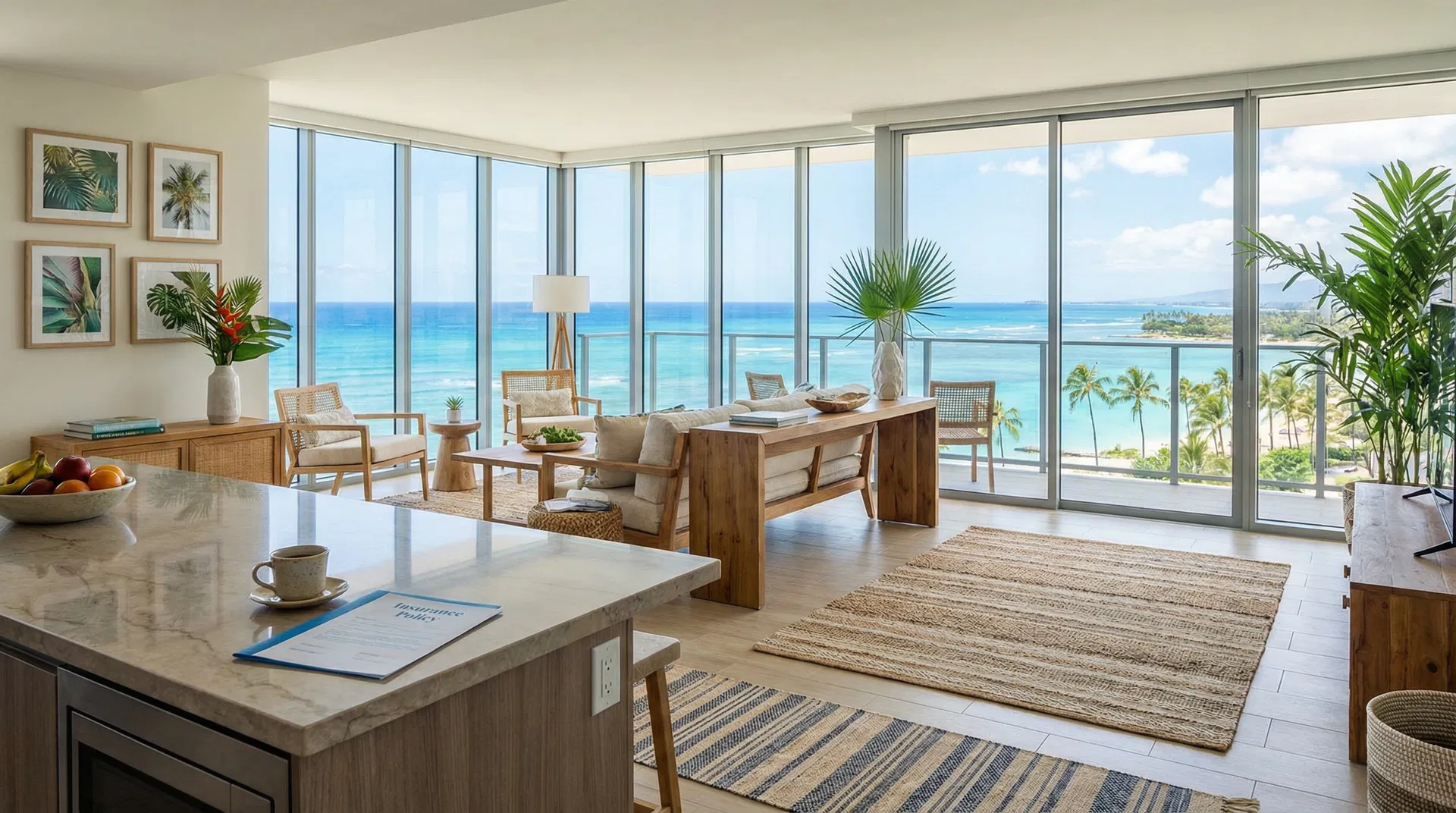
If you are buying a condominium in Hawaii, you will need two types of insurance protection: the master policy maintained by your condo association (known as the AOAO — Association of Apartment Owners — in Hawaii), and your personal unit-owners policy, known as an HO-6 policy. While most buyers focus on the purchase price and mortgage rate, understanding your HO-6 insurance is essential — especially in Hawaii's current insurance environment.
This article is a companion to our coverage of Hawaii's condo insurance crisis and focuses specifically on the HO-6 policy that protects your individual unit.
What Is an HO-6 Policy?
An HO-6 policy — sometimes called "condo insurance" or "walls-in coverage" — is a homeowners insurance policy designed specifically for condominium unit owners. It covers the interior of your unit, your personal belongings, your personal liability, and additional living expenses if your unit becomes uninhabitable due to a covered event.
The HO-6 policy works in tandem with the building's master insurance policy. The master policy covers the building's structure, common areas, and shared systems. Your HO-6 policy covers everything inside your unit that the master policy does not.
Master Policy Types: Bare Walls-In vs. All-In
The amount of HO-6 coverage you need depends heavily on the type of master policy your building carries. There are two primary types:
Bare Walls-In (also called "studs out" or "walls out"): This is the most common type in Hawaii. The master policy covers only the building's structural elements — the exterior walls, roof, floors, and common areas. Everything inside your unit from the drywall inward — including flooring, cabinets, countertops, plumbing fixtures, appliances, electrical wiring, and any improvements or upgrades you have made — is your responsibility to insure through your HO-6 policy.
With a bare walls-in master policy, your HO-6 dwelling coverage needs to be substantial. You are essentially insuring everything it would cost to rebuild the interior of your unit from the studs. For a typical two-bedroom condo in Honolulu, this could range from $50,000 to $150,000 or more depending on the unit's size, finishes, and any renovations.
All-In (also called "single entity"): This type of master policy covers the building structure plus the original fixtures, installations, and improvements as they were when the building was first built or as described in the original plans. Your HO-6 policy then only needs to cover your personal property, any upgrades or improvements you have made beyond the original condition, and your personal liability.
With an all-in master policy, your HO-6 dwelling coverage can be lower because the master policy already covers the original interior components. However, if you have renovated your kitchen, upgraded your bathrooms, or made other improvements, you need to ensure your HO-6 covers the cost of those upgrades.
How to determine your building's policy type: Request a copy of the building's master insurance policy or Certificate of Insurance from the AOAO. The policy type is specified in the declarations page. Your property manager or AOAO board should be able to provide this information.
What Your HO-6 Policy Covers
A standard HO-6 policy in Hawaii provides several types of coverage:
Dwelling Coverage (Building Property): Covers the interior structure of your unit — walls, floors, ceilings, built-in fixtures, and improvements. The amount needed depends on whether your building has a bare walls-in or all-in master policy.
Personal Property Coverage: Protects your furniture, electronics, clothing, appliances, and other personal belongings against covered perils such as fire, theft, vandalism, and water damage. Standard policies cover personal property on a "named perils" basis, meaning only specifically listed events are covered.
Loss of Use (Additional Living Expenses): If your unit becomes uninhabitable due to a covered event, this coverage pays for temporary housing, meals, and other additional living expenses while your unit is being repaired. In Hawaii, where hotel and rental costs are high, adequate loss-of-use coverage is particularly important.
Personal Liability: Provides financial protection if someone is injured in your unit or if you accidentally cause damage to another unit (for example, a water leak from your unit damages the unit below). Standard liability coverage is typically $100,000, but increasing to $300,000 or $500,000 is recommended.
Medical Payments to Others: Covers minor medical expenses for guests injured in your unit, regardless of fault. Standard coverage is typically $1,000-$5,000.
Loss Assessment Coverage: This is one of the most important and often overlooked coverages for condo owners. If the AOAO levies a special assessment on unit owners — for example, to cover a deductible on the master policy after a major loss, or to fund repairs that exceed the master policy limits — loss assessment coverage helps pay your share. Standard HO-6 policies include $1,000 in loss assessment coverage, but in Hawaii's current insurance environment, increasing this to $25,000-$50,000 or more is strongly recommended.
Why Lenders Require HO-6 Coverage
Mortgage lenders require HO-6 insurance as a condition of your loan because the condo unit serves as collateral for the mortgage. If the unit is damaged or destroyed and you cannot afford to repair it, the lender's collateral is at risk.
Lender requirements typically include:
- Dwelling coverage equal to at least the replacement cost of the unit's interior (the amount varies by lender and master policy type)
- The lender named as mortgagee on the policy so they receive notice of any changes or cancellations
- Continuous coverage maintained for the life of the loan
Fannie Mae and Freddie Mac guidelines specify that the HO-6 policy must provide coverage for at least the unit owner's insurable interest in the unit. The maximum deductible allowed is generally 5% of the dwelling coverage amount.
If you allow your HO-6 policy to lapse, your lender will purchase "force-placed" insurance on your behalf — which is significantly more expensive and provides minimal coverage. Maintaining your own HO-6 policy is always the better financial choice.
How Hawaii's Insurance Crisis Affects Your HO-6
Hawaii's condo insurance crisis, which we cover in detail in our companion article, has direct implications for your HO-6 policy in several ways.
Higher master policy deductibles mean more exposure for you. As master policy premiums have skyrocketed, many AOAOs have increased their deductibles to keep premiums manageable. A building that previously had a $25,000 deductible might now carry a $250,000 or even $500,000 deductible. If a covered event occurs and the AOAO must pay that deductible, it will likely be assessed proportionally to unit owners. Your loss assessment coverage is your protection against this scenario.
Gaps in master policy coverage create personal risk. If your building's master policy does not provide 100% replacement cost coverage — a situation affecting approximately 400 buildings in Hawaii as of mid-2024 — there is a coverage gap. In the event of a major loss, the shortfall would be assessed to unit owners. Again, robust loss assessment coverage is your safety net.
HO-6 premiums are rising. While HO-6 premium increases have been more modest than master policy increases, they are still trending upward in Hawaii. Expect to pay $300-$800 per year for a standard HO-6 policy in Honolulu, depending on your coverage levels, building age, and location. Policies with higher loss assessment coverage or additional endorsements will cost more.
Tips for Shopping HO-6 Coverage in Hawaii
Get quotes from multiple insurers. The Hawaii insurance market is competitive for HO-6 policies even as the master policy market has tightened. Compare quotes from at least three carriers.
Increase your loss assessment coverage. Given the current environment, $1,000 in loss assessment coverage is woefully inadequate. Increasing to $25,000-$50,000 typically costs only $25-$75 more per year and provides meaningful protection against special assessments.
Consider an umbrella policy. If you want liability coverage beyond the $300,000-$500,000 available on your HO-6, a personal umbrella policy provides an additional $1 million or more in liability protection for a relatively modest premium.
Understand your flood and earthquake exposure. Standard HO-6 policies do not cover flood or earthquake damage. If your building is in a flood zone (check FEMA's updated maps, with new Oahu maps taking effect April 29, 2026), you may need separate flood insurance. Earthquake coverage is available as an endorsement or separate policy.
Review your policy annually. As your building's master policy changes and as you make improvements to your unit, your HO-6 coverage needs may change. Review your policy each year at renewal time.
How HO-6 Premiums Affect Your Mortgage
Your HO-6 premium is included in your total housing cost when lenders calculate your debt-to-income ratio. While HO-6 premiums are typically modest compared to your mortgage payment and HOA fees, they are part of the equation.
If your lender requires an escrow account (common for loans with less than 20% down), your HO-6 premium will be collected monthly as part of your mortgage payment and paid by the servicer when due. If you do not have an escrow account, you are responsible for paying the premium directly to your insurer.
When budgeting for a Hawaii condo purchase, factor in the full insurance picture: your share of the master policy premium (included in your HOA fees), your HO-6 premium, and any additional flood or earthquake coverage. In today's market, insurance costs represent a larger share of total housing expense than they did just a few years ago.
Key Takeaways
Your HO-6 policy is your personal safety net as a condo owner. It protects your interior improvements, your personal property, and your financial exposure to building-wide assessments. In Hawaii's current insurance environment — with rising master policy costs, higher deductibles, and coverage gaps in many buildings — adequate HO-6 coverage is more important than it has ever been.
Before purchasing a condo, review the building's master policy type, understand what it does and does not cover, and work with an insurance agent to structure an HO-6 policy that provides comprehensive protection. And as always, factor the full cost of insurance into your homebuying budget.
If you have questions about how insurance costs affect your mortgage qualification or want to discuss the insurance landscape for a specific building you are considering, I am happy to help you work through the details.