
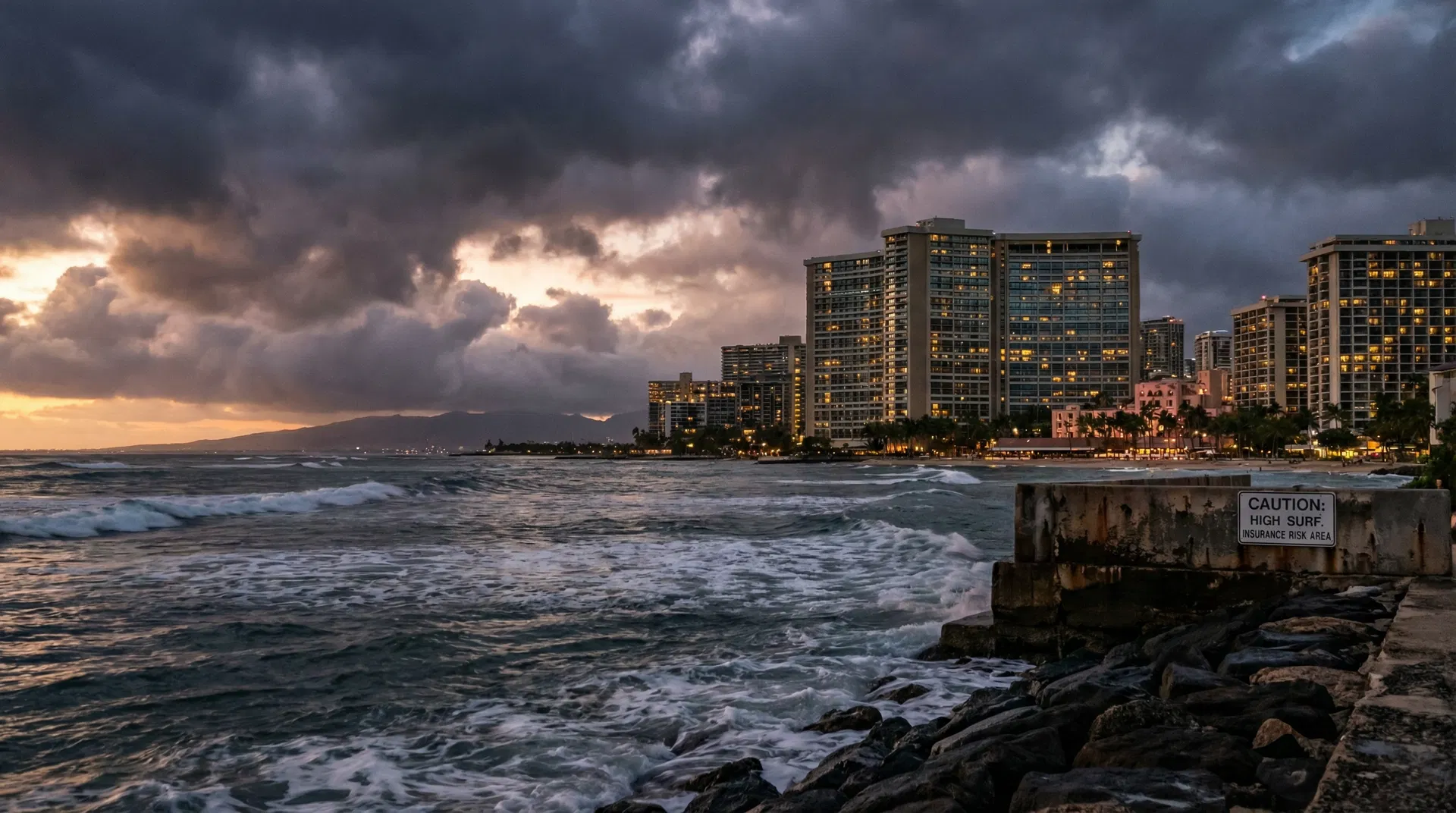
Hawaii's condominium market is navigating one of its most significant challenges in decades. A convergence of rising reinsurance costs, insurer withdrawals, climate-related risk repricing, and deferred building maintenance has created what industry observers and state lawmakers describe as a property insurance crisis — one that directly affects mortgage lending, property values, HOA fees, and the ability of buyers to finance condo purchases across the islands.
This article explains what is driving the crisis, how the state is responding, and what current and prospective condo owners should do to protect their investments.
What Is Driving the Crisis
Several factors have combined to create a "hard" insurance market in Hawaii, meaning coverage is more expensive, harder to obtain, and subject to stricter underwriting standards.
Rising Reinsurance Costs: Insurance companies purchase their own insurance — called reinsurance — to spread catastrophic risk. Global reinsurance prices have surged since 2022 due to a series of costly natural disasters worldwide. Because Hawaii's insurance market is small and geographically isolated, local insurers are especially sensitive to these global cost increases.
Climate-Related Risk Repricing: The devastating Maui wildfires of August 2023, which caused over $2.3 billion in insured losses, fundamentally changed how insurers assess risk across all Hawaiian islands. Combined with ongoing hurricane, flood, and earthquake exposure, insurers have dramatically increased premiums or reduced their appetite for Hawaii property coverage altogether.
Insurer Withdrawals: Several major insurance carriers have reduced their Hawaii exposure or stopped writing new condominium master policies entirely. Those that remain often limit their hurricane coverage to $10–25 million per building — far below the full replacement cost for most high-rise buildings. This forces condo associations to fill the gap through surplus lines insurers, which charge higher, unregulated rates.
Deferred Maintenance: Many of Hawaii's older condo buildings — particularly those built during the 1960s and 1970s construction boom — have fallen behind on critical maintenance such as plumbing replacement, electrical upgrades, and fire sprinkler installation. Insurers view these buildings as higher risk, resulting in steeper premiums or outright coverage denials. The 2017 Marco Polo high-rise fire, which killed four people and caused over $100 million in damage, led to 2023 state legislation requiring fire sprinkler retrofits in older high-rises, adding another financial burden for associations.
The Numbers Tell the Story
The scale of premium increases has been staggering. According to Hawaii Business Magazine, many condo associations have experienced insurance premium increases of 300% to 600% over the past two years. In one widely cited example, a Waikiki building saw its master policy premium jump from $235,000 to over $1.2 million, while its deductible increased tenfold.
The Hawaii Appleseed Center for Law and Economic Justice reported in December 2025 that homeowners across the state saw average premium increases of 12% between 2021 and 2024, while condominium associations faced even steeper increases averaging 16% during the same period. Statewide, homeowners' multiperil premiums rose 13.38% in 2024 alone, reaching $562.2 million.
These costs flow directly to unit owners through higher monthly HOA fees. According to the Honolulu Board of Realtors, condo HOA fees in Hawaii now range from $350 to over $1,000 per month, with insurance representing an increasingly large share of that total. Real estate analysts estimate that for every $100 increase in monthly fees, a condo loses approximately $20,000 in market value.
How the Crisis Affects Mortgage Lending
The insurance crisis has created a direct and serious problem for mortgage lending. Fannie Mae and Freddie Mac — the government-sponsored enterprises that purchase approximately 70% of residential mortgages from primary lenders — require that condominium buildings carry master insurance policies providing 100% replacement cost coverage.
When a building cannot obtain or afford full replacement coverage, the consequences cascade through the lending system. Lenders cannot sell those mortgages on the secondary market, which means they either stop lending on units in that building or impose significantly stricter terms. Buyers who want to purchase a unit in an underinsured building may find it impossible to obtain a conventional mortgage.
As of mid-2024, approximately 400 condominium buildings in Hawaii carried less than 100% insurance coverage. Fannie Mae has also been maintaining a list of buildings with known insurance or structural deficiencies — sometimes called a "blacklist" — that further restricts lending. If a building appears on this list, obtaining a mortgage for any unit in that building becomes extremely difficult, which in turn depresses property values for all owners.
The market data reflects this pressure. The Honolulu Board of Realtors reported that the median condo sales price on Oahu fell 4.4% from April 2024 to April 2025. The median number of days condos spent on the market before selling increased from 12 days in April 2022 to 43 days in April 2025. Available inventory expanded from 1.5 months to 6.8 months during the same period — a dramatic shift from a seller's market to a buyer's market for condos.
The State's Legislative Response: SB 1044
Recognizing the severity of the crisis, Governor Green convened a Joint Executive and Legislative Condo and Property Insurance Task Force in 2024. The task force's recommendations informed Senate Bill 1044, which was enacted on July 7, 2025, and represents the state's most comprehensive effort to stabilize the property insurance market.
The legislation has several key components:
Hawaii Property Insurance Association (HPIA) Expansion: HPIA, the state's insurer of last resort, is now authorized to write property insurance (excluding hurricane coverage) for eligible condominium buildings statewide. This provides a safety net for buildings that cannot obtain coverage in the private market. HPIA became operational for this expanded role in late 2025, with coverage limited to a maximum of 60 months per building.
Hawaii Hurricane Relief Fund (HHRF) Reactivation: The HHRF, which had been dormant, was reactivated and authorized to offer hurricane insurance policies to high-rise condominiums for the first time. The HHRF began accepting applications in mid-2025. To fund its operations, the HHRF can impose a temporary flat recording fee of up to $44 per property document and assess licensed property and casualty insurers.
Condominium Loan Program: SB 1044 created a new loan program administered by the Hawaii Green Infrastructure Authority, providing low-cost financing for critical building repairs such as pipe replacement, fire sprinklers, and roofing. The program is backed by $20 million in general obligation bonds and $5 million transferred from the HHRF. Additionally, C-PACER (Commercial Property Assessed Clean Energy and Resilience) loans were authorized for condo associations to fund resilience improvements.
Insurance Market Study: The legislation directs the Insurance Commissioner to conduct a comprehensive study on long-term strategies to stabilize Hawaii's property insurance market, with reports due in phases during 2026 and 2027.
Early Signs of Relief
By late 2025, there were encouraging signs that the legislative response was beginning to have its intended effect. Hawaii News Now reported in December 2025 that condo owners were seeing significant reductions in insurance premiums as the state-run insurance products created new competition in the market. The availability of HPIA and HHRF as backstop options appears to be giving private insurers more confidence to remain in or re-enter the Hawaii market, which in turn is putting downward pressure on premiums.
However, the recovery is uneven. Buildings that have addressed deferred maintenance and can demonstrate good risk management are seeing the most improvement. Older buildings with significant deferred maintenance or structural issues continue to face challenging insurance conditions.
What Condo Buyers Should Do
If you are considering purchasing a condo in Hawaii, the insurance landscape demands additional due diligence beyond what was necessary just a few years ago.
Review the Master Policy: Before making an offer, request a copy of the building's master insurance policy and current Certificate of Insurance. Verify that the building carries 100% replacement cost coverage. If it does not, understand that obtaining a conventional mortgage may be difficult or impossible.
Understand the Policy Type: Master policies come in two types — "bare walls-in" (covering only the building structure) and "all-in" (covering original fixtures and installations). This distinction determines how much personal HO-6 coverage you need for your individual unit.
Examine HOA Financials: Review the association's operating budget, reserve study, and recent meeting minutes. Look specifically at insurance line items to understand how much of your monthly fees go toward insurance and whether significant increases are anticipated. Ask about any pending or recently completed special assessments related to insurance or building repairs.
Check Lending Eligibility: Ask your lender whether the building is approved for conventional, FHA, or VA financing. If the building has known insurance deficiencies or appears on Fannie Mae's restricted list, financing options may be limited.
Assess Building Condition: Buildings that have kept up with maintenance — particularly plumbing, electrical systems, fire safety, and building envelope — are in the best position for favorable insurance terms. Ask about the building's maintenance history and any planned capital improvements.
Budget for Insurance Costs: Factor in both your share of the master policy (through HOA fees) and your personal HO-6 unit-owners policy. Standard HO-6 policies in Hawaii typically do not cover floods or earthquakes, and hurricane coverage often carries a separate, higher deductible (typically 2–5% of coverage). Consider additional loss assessment coverage, which protects you if the association levies a special assessment after a disaster that exceeds the master policy limits.
Note the New Flood Maps: FEMA released updated Flood Insurance Rate Maps for Oahu, with new maps scheduled to take effect on April 29, 2026. Properties newly placed in flood zones with federally backed mortgages will be required to carry flood insurance. If you are buying in an area that may be affected, factor this additional cost into your budget.
What Current Condo Owners Should Do
If you already own a condo in Hawaii, staying proactive is essential.
Stay Informed: Attend board meetings and review all communications about insurance renewals, premium changes, and special assessments. Understand how your building's insurance costs compare to similar properties.
Advocate for Maintenance: Support timely building maintenance and capital improvements. Buildings in good condition are more attractive to insurers and command better premium rates. Deferred maintenance is one of the primary factors driving coverage denials and premium spikes.
Review Your HO-6 Policy: Ensure your personal unit-owners policy provides adequate coverage for your interior improvements, personal property, and liability. Consider increasing your loss assessment coverage given the current environment.
Explore State Programs: If your building is struggling to obtain affordable coverage, encourage your board to explore HPIA and HHRF options, as well as the new Condominium Loan Program for needed repairs.
The Mortgage Perspective
From a lending standpoint, the condo insurance crisis underscores the importance of working with a lender who has deep experience in the Hawaii market. A knowledgeable local lender can help you navigate building-specific insurance issues, identify which buildings are eligible for conventional financing, and structure your loan to account for the full cost of ownership — including potentially elevated HOA fees.
If you are considering a condo purchase or refinance and have questions about how insurance conditions might affect your specific situation, I am happy to review the details with you and provide guidance tailored to your circumstances.
Key Takeaways
Hawaii's condo insurance crisis is a complex, evolving situation driven by global reinsurance costs, climate risk, insurer withdrawals, and deferred building maintenance. The state's legislative response through SB 1044 has created new safety nets and early signs of premium relief are emerging. However, buyers and owners must exercise heightened due diligence — reviewing master policies, understanding HOA financials, verifying lending eligibility, and budgeting for the full spectrum of insurance costs. Working with experienced local professionals who understand these dynamics is more important than ever.